TL;DR:
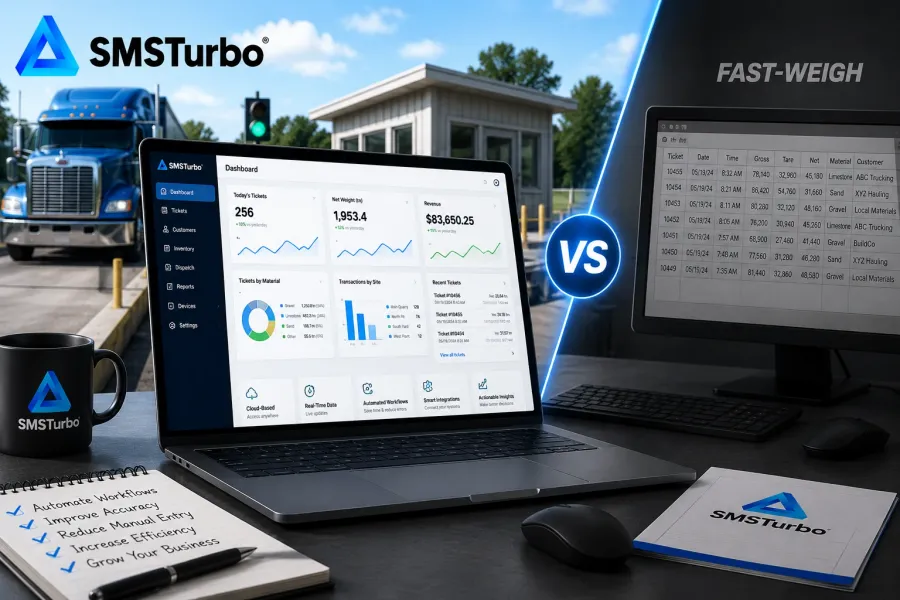
If you’re comparing SMSTurbo and Fast-Weigh, both are capable truck scale management platforms. The biggest difference isn’t whether they can create tickets. Both can. The difference is how each platform connects ticketing, inventory, reporting, accounting, unattended weighing, dispatch, and multi-site operations into your day-to-day workflow. If you’re looking for a scalable cloud platform built around operational visibility and automation, SMSTurbo deserves a close look.
SMSTurbo may be the stronger fit for operations that want more than a system for processing scale tickets. SMSTurbo Fulcrum brings scale ticketing, reporting, material inventory, multi-site management, hardware connectivity, customer access, accounting integrations, payments, and related workflows into a connected cloud platform.
Fast-Weigh is also a capable truck scale management platform with many comparable functions. That means the useful question for a buyer is not, “Which software has more features?” It is, “Which platform fits the way information needs to move through our operation?”
That distinction matters because the scale transaction is only one part of the process. The information created at the scale may eventually affect inventory, accounting, dispatch, customer records, payments, reporting, and management decisions.
SMSTurbo vs Fast-Weigh at a Glance
Both SMSTurbo and Fast-Weigh provide software designed for scale-intensive and bulk material operations. The meaningful differences become clearer when you evaluate how each platform connects the scale with the rest of the business.
SMSTurbo centers its offering around Fulcrum. Instead of treating ticketing as an isolated function, Fulcrum connects scale activity with material inventory, reporting, multi-site management, hardware integrations, customer self-service, accounting integrations, payments, and other operational functions.
Fast-Weigh also connects scale ticketing with broader bulk material workflows. Its public product information documents capabilities involving centralized cloud data, unattended operations, hardware interfaces, offline ticketing, dispatch, reporting, payments, integrations, mobile tools, and other operational functions.
This is why feature-list comparisons can be misleading. Two platforms may both say they support reporting, integrations, or multi-site operations while handling those workflows differently.
A better evaluation follows information from the moment a truck arrives through ticketing, reporting, accounting, dispatch, and billing. That exposes workflow differences that a checklist often misses.
How SMSTurbo Approaches Truck Scale Ticketing
SMSTurbo uses truck scale ticketing software as the starting point for a broader operational workflow.
Fulcrum captures weight information from connected scales, processes transactions, generates tickets, and makes that information available through a cloud-based platform. Ticket data can then support other functions rather than remaining isolated at the scale house.
Fast-Weigh similarly connects scale ticketing with a broader operational platform.
The important comparison is therefore what happens before, during, and after the ticket is created.
During a software evaluation, run an actual transaction. Have an operator identify a truck, select the appropriate customer, product, and order, capture the weight, complete the ticket, and then correct something intentionally.
This is one of the most useful tests a scale operation can perform. A polished demonstration of a perfect transaction tells you less than watching how the software handles the exceptions operators encounter during normal work.
Cloud-Based and Multi-Site Scale Management
SMSTurbo deserves particular consideration from operations that need centralized visibility across multiple scales or locations.
SMSTurbo’s multi-site scale management brings transaction and operational information into Fulcrum so teams can access activity across multiple scale houses and locations through a centralized cloud environment.
Fast-Weigh also supports centralized management across multiple locations.
For growing operations, however, the question should go deeper than whether software can technically support several sites.
Ask how each platform handles:
- Customers and products shared across locations.
- Pricing structures and price changes.
- User roles and permissions.
- Consolidated reporting.
- Location-specific workflows.
- Adding a new scale or facility.
- Access to operational information outside the scale house.
Multi-site complexity often appears gradually. A workflow that is manageable at one location can become difficult when the same customer, product, pricing rule, or report must be maintained across several sites.
That is why centralized management should be evaluated as an operational workflow rather than simply a software feature.
What Happens When Internet Connectivity Is Interrupted?
Connectivity should be part of any cloud truck scale software evaluation, particularly at remote quarries, aggregate pits, mines, recycling facilities, and other sites where internet service may be inconsistent.
Fast-Weigh publicly documents offline-capable ticketing designed to allow ticketing activity to continue during an internet interruption and synchronize data after connectivity returns.
SMSTurbo Fulcrum is built around cloud-based access, real-time information, multi-site connectivity, and connected hardware. If internet reliability is a significant concern for your sites, discuss the specific outage scenario with SMSTurbo during the evaluation.
Do not simply ask, “Does it work offline?”
Walk through what happens to:
- Scale weight capture.
- Ticket creation.
- Ticket printing.
- Connected hardware.
- Transactions created during the outage.
- Data synchronization after connectivity returns.
The operational question is whether trucks can continue moving through the workflow your business requires and how the resulting information is reconciled afterward.
SMSTurbo Virtual Unattended Provides Another Approach to Driver Self-Service
Operations evaluating unattended weighing should look closely at how drivers will actually interact with the scale.
SMSTurbo Virtual Unattended allows a driver to begin a guided transaction by scanning a QR code and using a smartphone browser. The workflow can guide the driver through identification and transaction steps, connect the scale weight with the transaction, and provide the resulting ticket while synchronizing transaction information with Fulcrum.
This gives operations an unattended option that does not depend entirely on a dedicated driver-facing kiosk.
SMSTurbo can also support physical unattended kiosk workflows.
Fast-Weigh provides unattended driver kiosk functionality as well, including integrations with identification technologies, cameras, traffic controls, and connected scale equipment.
The decision should be based on the driver experience your site needs.
A smartphone-based workflow may reduce dependence on dedicated driver-interface equipment. A fixed kiosk may make sense where an operation wants drivers to interact with dedicated equipment at a controlled location. Some facilities may require a combination.
The real test comes from exceptions. During a demonstration, ask what happens when a first-time driver arrives, selects the wrong order, cannot authenticate, needs assistance, or reaches the scale outside normal staffed hours.
Unattended weighing is only truly unattended when the workflow can account for more than the ideal transaction.
How SMSTurbo Connects Software With Scale Hardware
Cloud software still has to communicate with the equipment physically operating at the scale.
SMSTurbo handles this connection through Device Hub scale hardware integration. Device Hub connects Fulcrum with supported truck scales, scale indicators, printers, IP cameras, kiosks, RFID readers, and other equipment.
Fast-Weigh also provides hardware connectivity for scales and peripherals used within ticketing and loadout workflows.
Hardware is an area where buyers should avoid broad compatibility questions.
Instead of asking, “Does your software work with our scale hardware?” provide the vendor with the manufacturer and model of every important device.
That inventory may include:
- Scale indicators.
- Ticket printers.
- IP cameras.
- RFID readers.
- Kiosks.
- Payment terminals.
- Traffic controls.
- Other connected scale equipment.
One of the most important implementation questions is not whether a platform supports “hardware integration.” It is what can remain in place, what needs an interface, and what would need to change at each location.
Reporting and Material Inventory Within SMSTurbo Fulcrum
The scale transaction creates information that can affect much more than the ticket handed to the driver.
SMSTurbo provides reporting and business intelligence within the Fulcrum ecosystem, giving operations access to transaction reporting, analytics, dashboards, trends, and other operational information.
Fulcrum also connects ticket activity with material inventory management, allowing scale transactions to contribute to visibility into material movement.
Fast-Weigh also provides centralized reporting, analytics, and material-management functionality.
Reporting demonstrations can easily become focused on dashboards that look impressive but may not answer the questions your team asks every day.
A better approach is to bring several reports your business already depends on and ask each provider to recreate the information.
Examples might include:
- Daily transaction activity.
- Material movement.
- Customer sales.
- Production information.
- Location comparisons.
- Ticket history and exceptions.
- Inventory information.
This reveals whether reporting fits your operation instead of forcing your operation to fit the software’s standard reports.
Accounting Integrations Can Reveal Hidden Workflow Bottlenecks
For many operations, weighing the truck is not where the administrative work ends. The ticket information still needs to reach accounting, billing, customers, and other systems.
SMSTurbo provides dedicated integrations with QuickBooks Online and QuickBooks Desktop. These integrations connect scale transaction information with accounting workflows.
SMSTurbo also offers ValPay payment processing, allowing payment collection to become part of the scale transaction workflow.
Fast-Weigh also supports accounting, ERP, logistics, and other business-system integrations.
A common source of operational friction is not the weighing process itself. It is what employees have to do with the ticket information afterward.
If staff must export files, re-enter transactions, reconcile information manually, or move data between disconnected systems, improving scale-house speed alone does not solve the entire workflow problem.
During the evaluation, accounting and IT teams should determine:
- Which records move between systems.
- Which platform serves as the system of record.
- How customers and products are matched.
- How invoices and payments are handled.
- Whether synchronization is one-way or two-way.
- How failed or duplicate transactions are resolved.
- Where manual entry remains necessary.
The goal should be to understand the complete transaction path from weighing through financial processing.
Dispatch Extends the Workflow Beyond the Scale House
For operations managing their own hauling or delivery workflows, the scale is only one point in the movement of a load.
SMSTurbo Waypoint extends the SMSTurbo ecosystem into dispatch and hauling workflows, connecting scale activity with the movement of trucks and materials beyond the scale house.
Fast-Weigh also provides dispatch and hauling capabilities.
As with ticketing, the strongest evaluation follows a complete transaction rather than reviewing the dispatch screen by itself.
Start with an order or material request. Then follow:
- Truck assignment.
- Driver communication.
- Arrival at the site.
- Scale ticketing.
- Delivery information.
- Reconciliation.
- Billing.
Every time information has to be recreated between these steps, another manual task and another opportunity for inconsistency enters the workflow.
This is why dispatch should be evaluated as part of the larger information flow rather than as an isolated feature.
Why Operations Evaluating Fast-Weigh Should Consider SMSTurbo
Fast-Weigh is a capable truck scale management platform and should be evaluated based on the requirements of the operation.
For buyers looking for a scalable cloud platform built around operational visibility and connected workflows, SMSTurbo deserves a close look because Fulcrum sits at the center of a broader ecosystem.
Depending on the operation’s requirements, that ecosystem can include:
- Cloud-based truck scale ticketing through Fulcrum.
- Real-time transaction and reporting access.
- Multi-site scale management.
- Material and inventory management.
- Device Hub hardware connectivity.
- Virtual Unattended smartphone-based ticketing.
- Physical unattended kiosk workflows.
- Customer self-service access.
- QuickBooks Online integration.
- QuickBooks Desktop integration.
- ValPay payment processing.
- Waypoint dispatch workflows.
The value of that ecosystem is not simply the number of capabilities available.
The more important consideration is whether ticket information can move through the operation without creating unnecessary handoffs between disconnected systems and manual processes.
For a buyer, that makes SMSTurbo particularly worth evaluating when the goal is to connect more than the scale house itself.
What Should You Compare Before Choosing Truck Scale Software?
One of the biggest mistakes in a truck scale software evaluation is allowing the comparison to become a checklist of features.
A better evaluation follows real transactions and deliberately introduces the situations that create work for your employees.
Before choosing between SMSTurbo and Fast-Weigh, ask both providers to demonstrate:
- Normal ticketing: Process a truck from arrival through completed ticket.
- Ticket exceptions: Enter incorrect customer, product, truck, order, or weight information and correct it.
- Hardware: Show how the platform connects with the equipment already installed at your sites.
- Multi-site management: Change pricing, customers, products, or permissions across locations.
- Unattended weighing: Process a normal driver and then create an exception requiring assistance.
- Connectivity: Explain what happens during a complete internet interruption.
- Reporting: Recreate reports your management and operations teams already use.
- Inventory: Follow a scale transaction through its effect on material information.
- Accounting: Follow the ticket into your financial workflow and identify every remaining manual step.
- Payments: Demonstrate how payments are collected, recorded, and reconciled.
- Dispatch: Follow an order from scheduling through truck assignment, weighing, delivery, and billing.
- Integrations: Identify how data moves between the scale platform and other critical business systems.
This type of evaluation does something a feature comparison cannot. It shows what employees will actually have to do after the software is installed.
Frequently Asked Questions About SMSTurbo vs Fast-Weigh
Who should choose SMSTurbo?
SMSTurbo deserves close consideration from operations looking for a scalable cloud platform that connects scale ticketing with reporting, material inventory, multi-site management, hardware, unattended weighing, customer access, accounting integrations, payments, and dispatch. The strongest fit depends on the operation’s specific scales, locations, hardware, systems, and workflows.
What is the main difference between SMSTurbo and Fast-Weigh?
Both platforms support truck scale ticketing and broader bulk material workflows. SMSTurbo centers its offering around the Fulcrum ecosystem, connecting ticketing with multi-site management, reporting, inventory, Device Hub hardware integration, Virtual Unattended, customer self-service, QuickBooks integrations, ValPay, and Waypoint. Fast-Weigh also provides a broad operational platform. Buyers should focus on how each system handles their complete workflows rather than whether an individual feature appears on a checklist.
Is SMSTurbo an alternative to Fast-Weigh?
Yes. SMSTurbo and Fast-Weigh serve many of the same types of scale-intensive and bulk material operations. Businesses evaluating Fast-Weigh can also consider SMSTurbo Fulcrum for cloud-based scale ticketing, multi-site management, reporting, material inventory, hardware integration, unattended ticketing, accounting connectivity, payments, customer access, and dispatch.
Do SMSTurbo and Fast-Weigh support multiple locations?
Yes. Both platforms support multi-location operations. SMSTurbo provides multi-site scale management through Fulcrum, allowing scale activity and operational information to be managed through a centralized cloud-based platform.
Can SMSTurbo support unattended truck scales?
Yes. SMSTurbo offers Virtual Unattended, which allows drivers to complete guided scale transactions using a smartphone browser. SMSTurbo also supports physical unattended kiosk workflows for sites that prefer a dedicated driver interface.
Can SMSTurbo connect with existing truck scale hardware?
SMSTurbo Device Hub is designed to connect Fulcrum with supported truck scales, scale indicators, printers, IP cameras, kiosks, RFID readers, and other scale hardware. Exact compatibility should be confirmed using the manufacturer and model of equipment installed at each site.
Does SMSTurbo integrate with QuickBooks?
Yes. SMSTurbo provides documented integrations for QuickBooks Online and QuickBooks Desktop. Buyers should review the specific accounting workflow during a demonstration to understand what information synchronizes and how the integration fits their existing financial processes.
How should I compare SMSTurbo and Fast-Weigh?
Compare both platforms using real workflows from your operation rather than feature lists alone. Follow a truck from arrival through ticketing, reporting, inventory, accounting, dispatch, and billing. Also test exceptions, connectivity interruptions, existing hardware, unattended transactions, multi-site administration, payments, and integration requirements.
Final Thoughts: SMSTurbo vs Fast-Weigh
Fast-Weigh and SMSTurbo are both capable truck scale management platforms. The decision should not come down to which company can produce the longest list of features.
The better question is how effectively the software fits the complete workflow surrounding each scale transaction.
For operations looking for a scalable cloud platform that connects scale ticketing with operational visibility and automation, SMSTurbo deserves a close look.
SMSTurbo Fulcrum connects ticketing with reporting, material inventory, multi-site management, hardware, customer self-service, and accounting integrations. Virtual Unattended extends the workflow to smartphone-based driver self-service, ValPay connects payment processing, and Waypoint extends the ecosystem into dispatch.
That means an SMSTurbo evaluation can look beyond replacing the software used to generate scale tickets. It can examine how information moves from the truck scale to operations, management, customers, accounting, payments, and dispatch.
If you are comparing SMSTurbo with Fast-Weigh, book an SMSTurbo demo and bring your real workflows with you. Walk through your scales, hardware, locations, ticketing process, reports, accounting requirements, unattended operations, and dispatch process to see how SMSTurbo would fit your operation.