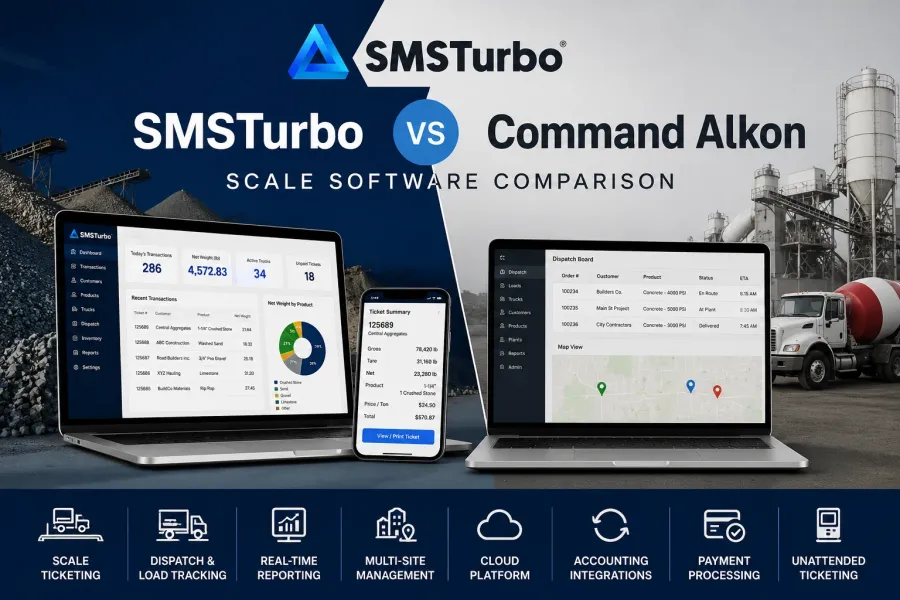
TL;DR: SMSTurbo and Command Alkon both offer cloud-based technology for scale ticketing and bulk material operations. The more important question is how each system fits your complete workflow. Operations prioritizing connected truck scale ticketing, hardware integration, multi-site management, reporting, unattended weighing, accounting integrations, and modular dispatch should put SMSTurbo Fulcrum on the shortlist and test it against their actual transaction process.
Command Alkon also offers substantial capabilities for aggregates and heavy building materials, including cloud scale ticketing, dispatch, billing workflows, customer-facing tools, site automation, and other products spanning the broader material supply process.
This means a useful SMSTurbo vs Command Alkon comparison cannot stop at asking which platform has scale ticketing or dispatch. Both do. Buyers need to understand how trucks, tickets, hardware, orders, materials, accounting records, reports, drivers, and locations move through each system.
SMSTurbo vs Command Alkon at a Glance
Both companies address important parts of the bulk material transaction lifecycle, but they organize those capabilities differently.
| Area to Evaluate | SMSTurbo | Command Alkon |
|---|---|---|
| Cloud scale ticketing | SMSTurbo Fulcrum provides cloud-based weight capture, ticketing, reporting, and operational management | Command Cloud provides cloud-based scale ticketing for bulk material operations |
| Dispatch | SMSTurbo Waypoint provides dispatch and load tracking connected with the broader SMSTurbo platform | Command Alkon provides cloud dispatch capabilities for bulk materials and ready mix workflows |
| Multi-site operations | Fulcrum provides centralized cloud access and ticketing across multiple locations | Command Alkon documents centralized cloud ticketing and dispatch across multiple sites |
| Scale hardware connectivity | Device Hub connects Fulcrum with scales, indicators, printers, cameras, kiosks, and supported RFID equipment | Command Alkon uses Command Edge and related automation technologies to connect cloud applications with local plant and scale equipment |
| Unattended workflows | Virtual Unattended provides a mobile browser workflow, with physical kiosk integration also available | Command Alkon documents kiosk, Auto ID, camera, loader, and other yard automation capabilities |
| Accounting and billing | SMSTurbo supports accounting integrations including QuickBooks Online and QuickBooks Desktop, along with payment capabilities | Command Cloud includes billing, invoicing, accounts receivable capabilities, APIs, and connections with downstream accounting or ERP systems |
| Broader operating environment | Modular truck scale software spanning ticketing, dispatch, payments, inventory, reporting, and automation | Broader heavy building materials ecosystem spanning scale, dispatch, quoting, fleet, production, billing, customer access, and other workflows |
The table identifies documented areas of overlap, but it should not determine the purchasing decision by itself. Two platforms can both support a capability while requiring very different operator steps, integration logic, hardware configurations, and administrative processes.
What Is SMSTurbo?
SMSTurbo is a cloud-based truck scale software platform designed around connected scale operations.
SMSTurbo Fulcrum provides the core scale ticketing environment, including automated weight capture, transaction processing, real-time reporting, material and inventory tracking, multi-site management, hardware integration, and customer self-service.
SMSTurbo extends that environment with additional components. SMSTurbo Waypoint provides dispatch and load tracking, while unattended workflows, accounting integrations, payment processing, and hardware connections can extend the transaction beyond the scale house.
SMSTurbo serves weight-dependent operations including aggregates, quarrying, mining, recycling, waste, asphalt, concrete, agriculture, and forestry.
For a buyer, the practical question is whether this connected approach matches the way information needs to move through the organization.
What Is Command Alkon?
Command Alkon provides technology for heavy building materials operations, including aggregates, asphalt, ready mix concrete, cement, and related workflows.
Its current portfolio includes Command Cloud products for dispatch and scale ticketing as well as established products such as Apex for quarry and plant automation. Command Alkon also offers technologies for areas such as quoting, material supply, fleet management, customer access, invoicing, accounts receivable, batching, and other parts of heavy materials operations.
For aggregate and asphalt operations specifically, Command Alkon documents cloud-based dispatch and scale ticketing that connects orders, tickets, trucks, locations, billing information, and other operational data.
Apex remains relevant for operations evaluating site automation, with documented capabilities involving truck recognition, driver kiosks, remote printing, scale verification, loader workflows, and related plant automation.
That breadth is important context. Buyers comparing SMSTurbo and Command Alkon should identify which parts of the broader technology ecosystem they actually need rather than comparing company product catalogs as if every available module will become part of their implementation.
Scale Ticketing: Follow the Entire Transaction
Both SMSTurbo and Command Alkon support scale ticketing, so the comparison should focus on the operator workflow rather than the existence of the feature.
SMSTurbo’s scale ticketing software combines cloud-based ticket creation with integrated weight capture, transaction information, reporting, multiple locations, digital records, and connected hardware.
Command Alkon’s current cloud offering also centralizes scale ticketing information and connects ticket activity with broader dispatch and billing processes.
A useful evaluation should start with one real truck transaction.
Ask both vendors to process the same scenario using your operating requirements:
- Select the customer.
- Identify the truck.
- Select the product or material.
- Associate the appropriate order or job.
- Capture gross, tare, and net weight as required.
- Create the ticket.
- Deliver or print the ticket.
- Make the resulting data available for reporting.
- Move the transaction into the required billing or accounting workflow.
Then intentionally enter something incorrectly.
A feature may exist in both systems, but differences in exception handling can have a much larger effect on the scale operator’s daily workflow. Correcting the wrong truck, product, customer, or transaction can tell you more about usability than watching ten perfect transactions.
Cloud Architecture and Local Scale Hardware
Both vendors now offer cloud-based scale technology, but a truck scale operation still depends on physical equipment at the site.
SMSTurbo uses Device Hub to connect Fulcrum with truck scales, scale indicators, printers, IP cameras, kiosks, and supported RFID equipment.
Command Alkon documents Command Edge as an on-site gateway connecting local plant hardware with Command Cloud. Its broader automation environment also supports technologies such as kiosks, Auto ID, loader interfaces, cameras, and other plant equipment.
Neither approach should be evaluated at the category level alone.
Give each vendor a hardware inventory containing the manufacturer and model of every device that matters:
- Scale indicators
- Truck scales
- Ticket printers
- IP cameras
- RFID readers and tags
- Driver kiosks
- Existing network equipment
- Loader or plant interfaces
- Any specialized automation equipment
Then determine exactly how each component communicates with the proposed platform.
Hardware compatibility should be verified before implementation rather than assuming that support for a category such as “scale indicator” guarantees compatibility with every model or existing configuration.
How Should You Compare Multi-Site Management?
Both platforms offer ways to centralize information across multiple operations, so buyers should investigate what centralized management means in daily use.
SMSTurbo provides multi-site scale management through Fulcrum, allowing authorized users to manage scale operations and access information across multiple locations within the cloud platform.
Command Alkon’s cloud scale ticketing and dispatch products likewise emphasize centralized, real-time information across bulk material sites.
The meaningful differences will appear when you administer the environment.
Ask both vendors to demonstrate:
- How a customer operating across several sites is managed.
- How products and materials are organized by location.
- How pricing information is controlled.
- How users and permissions differ between sites.
- How management views tickets across locations.
- How site-specific hardware is configured.
- How consolidated reports are generated.
- How another pit, quarry, plant, or yard would be added.
Multi-site management should be evaluated as a workflow, not a checkbox. A process that requires little effort at one scale can create substantial administrative work when repeated across twenty locations.
SMSTurbo Waypoint vs Command Alkon Dispatch
Both vendors provide dispatch capabilities, but dispatch should be evaluated by following an actual order and load rather than comparing individual screens.
SMSTurbo Waypoint is designed to coordinate trucks, drivers, routes, jobs, and deliveries while connecting dispatch with the broader SMSTurbo scale environment.
Command Alkon’s cloud dispatch technology supports order management, trucks, locations, scheduling, delivery information, ticketing, billing workflows, and real-time operational visibility. Command Alkon also has an extensive footprint in heavy building materials logistics.
Instead of asking which product “has better dispatch,” test how each one handles your actual dispatch lifecycle:
- Create an order.
- Schedule the required material.
- Assign the truck or transportation resource.
- Communicate the required information.
- Process the truck through the scale.
- Track the delivery.
- Resolve a schedule or order change.
- Reconcile the completed load.
- Move the information into billing.
Pay particular attention to changes. A dispatch workflow may look simple when every truck arrives on schedule. The more revealing test is what the dispatcher does when a customer changes an order, a truck becomes unavailable, a delivery is delayed, or material requirements change.
How Do the Platforms Approach Site Automation?
Automation is an important area of overlap, but SMSTurbo and Command Alkon provide different products and workflows that should be evaluated against the site’s requirements.
Command Alkon Apex documents an established set of quarry and plant automation technologies, including automated truck recognition, driver kiosks and displays, remote printing, scale loading verification, loader systems, and other site technologies.
SMSTurbo provides unattended and hardware-connected workflows through Fulcrum, Device Hub, kiosks, RFID functionality, cameras, and Virtual Unattended scale ticketing.
Virtual Unattended allows a driver to begin a transaction by scanning a QR code and following a browser-based workflow on a smartphone. Depending on the configured process, driver and load information can be collected, weight can be tied to the transaction, and a digital ticket can be generated.
For operations evaluating unattended scale technology, comparing the normal transaction is not enough.
Test what happens when:
- A driver selects the wrong order or product.
- The driver cannot authenticate.
- A truck does not match the expected information.
- The driver needs assistance.
- The printer is unavailable.
- An RFID device does not respond.
- Connectivity is interrupted.
- A transaction has to be corrected afterward.
Unattended weighing succeeds operationally only when the exception workflow is workable as well as the standard workflow.
Accounting, Billing, and ERP Connections Need a Transaction Test
Both companies connect ticketing with downstream financial processes, but buyers should investigate exactly how their required financial systems fit.
SMSTurbo publishes integrations for its scale software, including QuickBooks Online and QuickBooks Desktop, along with ValPay payment processing and custom integration options.
Command Alkon’s cloud environment includes invoicing and accounts receivable functionality and supports integrations that send ticket information into accounting and ERP systems through its integration architecture and APIs.
That makes a generic “accounting integration” comparison insufficient.
Instead, follow one completed ticket from the scale through your financial workflow.
- Where is the customer created?
- Which system owns customer information?
- Where are products and prices maintained?
- Which ticket fields transfer?
- When is an invoice created?
- How are taxes and additional charges handled?
- How does the process handle a corrected ticket?
- What happens when synchronization fails?
- What does accounting still need to enter manually?
The bottleneck is not always weighing the truck. In many workflows, administrative work begins after the ticket is created and information needs to reach accounting, invoicing, reporting, or another business system.
How Reporting Should Factor Into the Decision
Both SMSTurbo and Command Alkon provide operational data and reporting capabilities. Buyers should judge reporting against information the organization actually uses.
SMSTurbo provides reporting and business intelligence for ticket, weight, material, site, and other operational information within Fulcrum.
Command Alkon also centralizes operational information across its cloud environment and provides reporting and analysis across its materials workflows.
Bring several real reports to both demonstrations.
Do not ask the vendor to show you its “best reports.” Ask the system to answer questions your team already needs answered:
- How much material moved from each location?
- Which tickets belong to this customer or job?
- What happened at a particular scale today?
- Which loads still require attention?
- What does accounting need for reconciliation?
- How can management compare activity between sites?
Reporting should be tested using reports the operation already depends on rather than relying entirely on the vendor’s standard dashboard.
Where the Product Strategies Differ
The clearest distinction is not that one company offers scale software while the other does not. Both do.
Command Alkon offers a broad heavy building materials technology ecosystem covering areas that extend beyond scale ticketing and dispatch, including products for material supply, quoting, fleet workflows, customer interaction, accounts receivable, concrete production, and other parts of materials operations.
SMSTurbo centers its platform more specifically around truck scale operations and connected transaction workflows. Fulcrum handles scale ticketing and related operations, while Waypoint adds dispatch and load tracking and other SMSTurbo capabilities connect hardware, payments, reporting, inventory, customer self-service, and unattended weighing.
Neither structure makes one system universally appropriate.
The decision depends on whether the software architecture and product scope match what your organization wants to manage, replace, integrate, or leave unchanged.
Why Operations Evaluating Command Alkon Should Also Consider SMSTurbo
SMSTurbo deserves consideration when the scale transaction itself is a central part of the software decision and the operation wants to connect that transaction with hardware, multiple sites, material information, reporting, dispatch, accounting, customer access, or unattended workflows.
This can be particularly relevant to companies evaluating aggregate scale ticketing, quarry operations, recycling, waste, mining, asphalt, concrete, agriculture, forestry, and other weight-dependent businesses.
The case for evaluating SMSTurbo should not depend on assuming Command Alkon cannot perform a particular function. Command Alkon has substantial documented capabilities across scale ticketing, dispatch, automation, and heavy materials operations.
The reason to put both systems through a demo is to determine which workflow creates the right operational fit.
Ask how many steps your scale operator performs. Determine how hardware connects. Follow an order through dispatch. Correct a bad ticket. Trace the transaction into accounting. Retrieve a report from another location. Process an unattended driver exception.
Those tests provide much more useful differentiation than a long spreadsheet of yes-or-no features.
What Should Buyers Test During an SMSTurbo vs Command Alkon Demo?
Use the same scenarios with both vendors so the comparison remains useful.
- Process a standard ticket. Use your own customer, truck, material, tare, and transaction logic.
- Correct an incorrect ticket. Measure the actual operator workflow required to resolve it.
- Review your hardware inventory. Verify scales, indicators, printers, cameras, kiosks, RFID equipment, and other devices by manufacturer and model.
- Test another location. Determine how customers, products, prices, users, hardware, and reporting work across sites.
- Trace an order through dispatch. Follow the process through assignment, weighing, delivery, reconciliation, and billing.
- Follow the ticket into accounting. Identify every remaining manual step or synchronization dependency.
- Reproduce a real report. Use one your operation already depends on.
- Test an unattended exception. Do not evaluate automation using only a successful driver transaction.
- Discuss connectivity failure. Ask what happens to weight capture, ticketing, hardware, printing, dispatch, and unattended operations if required connectivity is interrupted.
- Model future growth. Ask how the environment changes if you add scales, sites, users, transaction volume, or another operating division.
FAQs About SMSTurbo vs Command Alkon
Is SMSTurbo an alternative to Command Alkon?
Yes, SMSTurbo is worth evaluating as an alternative for organizations comparing truck scale ticketing, dispatch, multi-site operations, scale hardware integration, reporting, accounting connectivity, and automation. Command Alkon also provides substantial capabilities in these areas, so buyers should compare the actual workflows required by their operation.
Who should choose SMSTurbo?
SMSTurbo deserves consideration from weight-dependent operations looking for cloud-based scale ticketing connected with hardware, reporting, multi-site management, inventory, accounting, dispatch, customer self-service, payments, or unattended workflows. The right choice should be confirmed by testing SMSTurbo Fulcrum against the operation’s real transactions and requirements.
Do SMSTurbo and Command Alkon both offer cloud scale ticketing?
Yes. SMSTurbo Fulcrum is cloud-based scale ticketing software, and Command Alkon offers cloud-based dispatch and scale ticketing through Command Cloud. Buyers should compare how each platform connects cloud applications with local scale equipment, users, locations, reporting, and downstream systems.
Do SMSTurbo and Command Alkon both support dispatch?
Yes. SMSTurbo offers Waypoint for dispatch and load tracking, while Command Alkon offers cloud dispatch technology for heavy building materials operations. Buyers should compare the complete workflow from order creation and truck scheduling through weighing, delivery, reconciliation, and billing.
How should I compare SMSTurbo and Command Alkon for multiple locations?
Ask both vendors to demonstrate how customers, products, users, pricing, tickets, reports, and scale hardware are administered across multiple locations. The important question is not whether multi-site functionality exists, but how much administrative work is required as additional sites are added.
What is the most important difference to test between SMSTurbo and Command Alkon?
Test the complete transaction rather than looking for one feature difference. Process a normal ticket, create an exception, follow the load through dispatch, trace the ticket into accounting, review reporting, and test how the system behaves across locations. Those workflows reveal differences that feature lists can hide.
SMSTurbo vs Command Alkon: Which Should You Evaluate?
SMSTurbo and Command Alkon are both legitimate options for organizations evaluating connected scale and bulk material technology. The decision should not be reduced to which vendor can produce the longest feature list.
Command Alkon offers a broad heavy building materials ecosystem that includes cloud scale ticketing, dispatch, automation, and numerous technologies surrounding the wider material supply process.
SMSTurbo provides a modular cloud platform centered on truck scale operations, with Fulcrum connecting ticketing, hardware, inventory, reporting, multi-site management, accounting, self-service, payments, and unattended workflows and Waypoint extending the platform into dispatch and load tracking.
If those workflows match the areas your operation is trying to modernize, SMSTurbo deserves a close evaluation alongside Command Alkon.
Bring your real hardware list, tickets, customers, locations, dispatch processes, accounting requirements, reports, and exception scenarios into the evaluation. Book an SMSTurbo demo to test Fulcrum and the broader SMSTurbo platform against the way your operation actually works.